
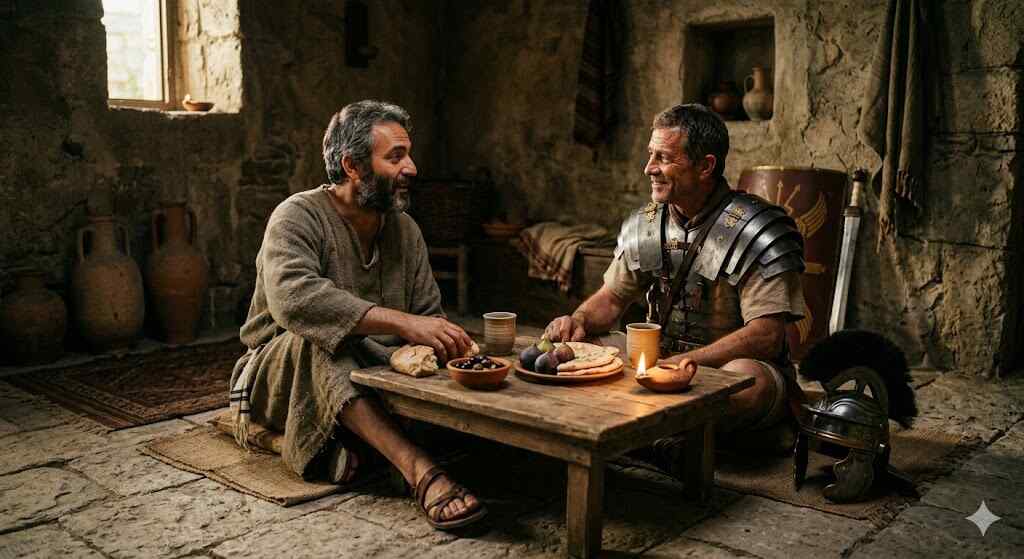
Its the first century AD, by all accounts, Cornelius should have disliked the Jews, that includes Jesus.
The Roman occupation of Judea was absolutely brutal, defined by massacres and daily humiliation. While many of Rome’s legionnaires were conscripts forced to serve, Cornelius chose this role. He was a volunteer from Rome who trained specifically to practice Roman dominance on peoples throughout the empire. Moreover, Cornelius performed well in his duties; as a Centurion, he was expected to model proper Roman barbarity so that his soldiers would emulate this ideal without hesitation.

However, just as God tells us that the Torah is written on the hearts of all men, Cornelius recognized the justice, compassion, and righteousness of the God of the Jews. While his fellow Romans embraced polytheism, sexual cults, and hedonism, Cornelius chose the virtue of the God of Israel.
He was one of what the New Testament calls “God-fearers.” Many Romans, though certainly not a majority, worshipped the God of the Jews. But this was a difficult existence for men like Cornelius. They were permitted in the synagogue, yet they were not permitted to be part of the minyan ( (a quorom of ten men required before a Sabbath service could take place). They worshipped God but were not seen as part of the Covenant. In a sense, they were whole in following God, but in another sense, they were homeless, unable to fully become one with the Jewish community.
When Cornelius went to the synagogue to interact with his Jewish friends, those who did not know him personally, likely viewed him with the same fear and suspicion they would any Roman soldier. Jews had learned that Roman soldiers brought very little but the sword, cruelty, and oppression. As such, the Jews created protective barriers.
For example, after the synagogue service, Cornelius may not have been always welcome to eat with Jews. In the ancient world, eating was not a solitary activity done quickly just to fuel the body; it was a social act. It was bonding; it was breaking bread. This is why we see repeatedly in Scripture that feasting is a sign of fellowship. It was the ultimate way of showing trust.
This is why Peter was hesitant and required avision from the Lord to accompany Cornelius’ servants.
Like the homes of so many Romans, was it likely that his home contained altars to pagan gods? Was his food consecrated to idols? Was it likely Cornelius’ home was spiritually unclean?
This is what makes the bond of food between Peter and Cornelius so significant. When Cornelius sends for Peter to dine with him, he knows what an extraordinary leap of faith he is asking Peter to make. And when Peter goes, he knows what a taboo this represents to himself and other Jews.
But God comes to Peter in a vision and says, “Rise, Peter; kill and eat,” for no one is unclean.
For centuries, Christians have interpreted this to mean that no animal is unclean,that the prohibitions against eating non-kosher animals no longer apply. But not only is this interpretation narrow, it eliminates the profound moment actually taking place. God is communicating to Peter that, despite the valid fears of Jews regarding the Romans, no person is unclean if they seek to know God. While someone might be spiritually unclean if they remain under the yoke of paganism, if they seek to know the God of Israel, that barrier is removed.
So Peter goes to eat with him. Scripture doesn’t tell us what Peter found in the home of Cornelius, but we do know Cornelius was a God-fearer respecting the Torah. Therefore, it is safe to assume there were no pagan altars in his home. He would have been intimately familiar with the dietary commands God gave the Jewish people; if his home was not kosher by the standards of the day, we can assume he would not have dared to offer Peter unclean food.
Later, when Peter arrives back in Jerusalem and informs the leadership there that he had been with Cornelius, the other Jewish followers of Jesus respond harshly, asking why he had dined with an uncircumcised soldier of the occupation, an occupation that spat on the Torah and hated the God of the Jews. Peter responds that by seeking to know God, Cornelius was no longer ‘unclean’.
In this passage, we see Cornelius blessing Peter with material things, the meal, because he had seen the Jews bless him with spiritual things, their God.
“For they were pleased to do so, and they are indebted to them. For if the Gentiles have shared in their spiritual things, they are indebted to do them a service also in material things.” Romans 15:27
In this way we as Christians can again bless God’s people in Israel by ministering to their material things through Leket Israel the National Food Bank!
A very helpful and informative understanding, shared with sensitivity. Thank you.
This makes me see a different perspective from what I was though, the revelation of this writing gave me a better understanding.
Thank you for stressing Rom.15,27. Have read it before. Now it ‘sticks’ even more.
Thank you for this excellent interpretation!! I am sharing it with friends & family who never seem to read the explanation in the Scriptures following the story. Picking & choosing what to read never works! In a way, part of the fault lies with breaking the Word, our daily spiritual bread, up in chapter & verse & subheadings. Ingesting half is being half filled. Still lacking, still hungry!